When surfing the internet recently we stumbled upon an ESPN (Greg Wyshynski) article asking NHL players (among other things) which rule they would most like to change.
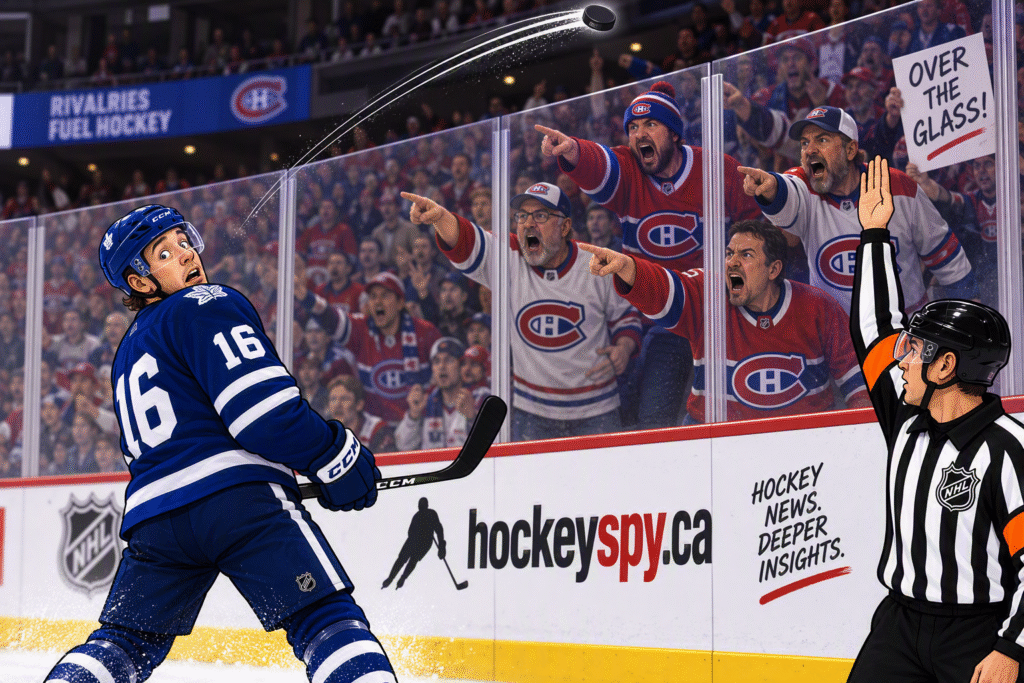
Philadelphia Flyers defenceman Jamie Drysdale nominated the automatic delay-of-game penalty for shooting the puck over the glass from the defensive zone.“I don’t think there’s a person in the history of the game who purposefully puts the puck over the glass,” Drysdale said.
To that, we say, “Nonsense.”
Perhaps not under the current rule—because doing so now results in an automatic two-minute penalty. Take away that consequence and see how long it remains accidental. Professional athletes—and this includes hockey players—always have and always will look for any tiny advantage, legal or not, that leads to victory.
The NHL introduced the automatic penalty in 2005. Before then, deliberately shooting the puck out of play was already against the rules, but only if a referee believed the act was intentional. That was the problem: officials almost never made the call.
How could they? Unless a player confessed (heh-heh😁), a referee could not know with certainty whether the puck sailed over the glass deliberately or because of a bad bounce, poor execution or simple panic. Players could send the puck into the crowd, shrug their shoulders and insist that they had been trying to bank it off the glass.
That left the NHL with a rule that existed in the book but was practically impossible to enforce. The current rule removed the guesswork. If a defending player shoots the puck directly over the glass from his defensive zone, without it touching the boards, glass or another player, it is a penalty. Intent no longer matters. That may seem harsh when a player clearly makes a mistake, but hockey penalties have never been based entirely on intent. A player who accidentally clips an opponent with a high stick or unintentionally trips someone is still sent to the sin bin.
Carolina Hurricanes defenceman Jaccob Slavin also considers the rule unnecessary.
“The puck-over-the-glass penalty. I’ve had too many of those,” Slavin said. “I won the Lady Byng and my one penalty was puck over the glass. That’s not why I’m against it, but that’s just a good example of it being a silly penalty.”
Actually, it is a good example of why the rule works.
Slavin is one of the NHL’s most disciplined players, yet even he has put the puck over the glass while trying to escape pressure. The penalty is not an accusation of dirty play or poor sportsmanship. It is simply the consequence of an illegal clearing attempt.
According to statistics published by Scouting the Refs, puck-over-glass penalties represented 2.7 per cent of all penalties last season. That increased to 3.4 per cent in the playoffs and 7.7 per cent in playoff overtime—although that last figure came from a sample of only 13 total overtime penalties.
Those figures are being used to criticize the rule, but they may reveal something else.
NHL referees have a well-established tendency to “let the players decide the game” during the playoffs, particularly in overtime. Hooks, holds, trips and interference that might be penalized in October can suddenly become acceptable in May.
The puck-over-glass rule is different. It is objective, visible and mandatory. Referees cannot quietly lower the standard or decide that it is too late in an important game to make the call.
That is not a weakness. It is one of the rule’s greatest strengths.
If the NHL returned to judging intent, does anyone seriously believe officials would call a deliberate puck-over-glass penalty late in a tied playoff game? They were reluctant to make that decision before 2005, and today’s cowardly referees—who repeatedly avoid getting involved in big games—would be less likely to do it now.
Players and coaches study every rule and search for every possible advantage. If shooting the puck into the crowd became merely an icing—or brought only a warning—tired defenders trapped in their own zone would immediately recognize the value of that option. A defensive-zone faceoff without a line change might be preferable to another 20 seconds of scrambling while exhausted players chase the puck. In the closing seconds of a game, stopping the clock alone could be worth the risk. Before long, referees would once again be expected to read minds.
The Scouting the Refs website reports that 92 delay-of-game penalties were called across the entire NHL in 2003-04, including every type of delay infraction. After the automatic puck-over-glass rule arrived, there were 416 minors for that offence alone. End of story.
It’s not surprising to hear that today’s players don’t like the rule. Wearing the goat horns after paying the price can be humiliating. But the only alternative is to return to a rule based on a referee’s willingness to make a controversial judgement call with a game or series on the line.
We already have enough of those.
Keep the automatic penalty.