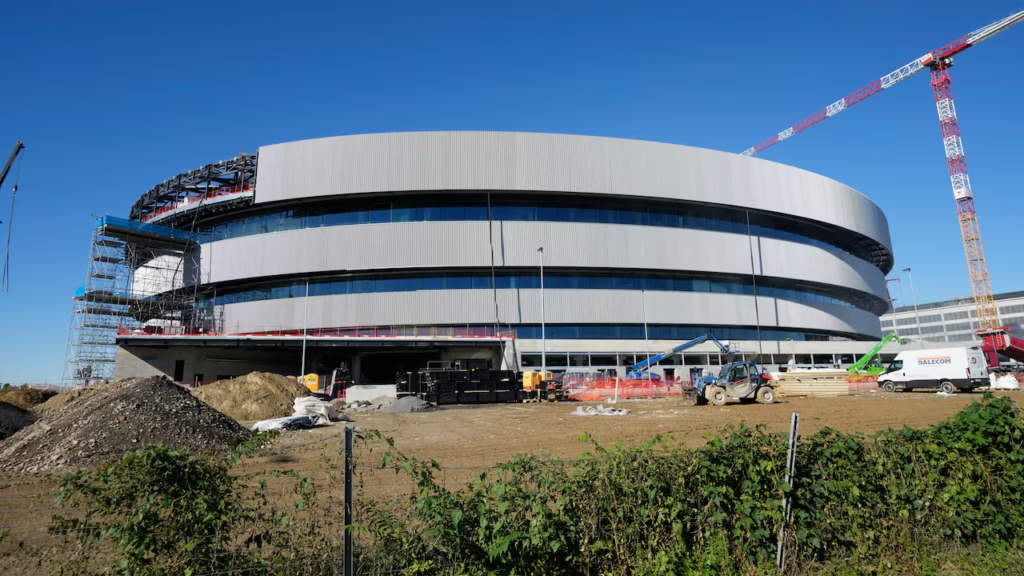
When Olympic hockey makes headlines, it’s usually for the games. This time, it’s for the arena — or more accurately, the maybe-arena that remains unfinished, untested, and now appears to feature an undersized ice surface, which is odd when you consider the Olympics tends to go big — real big — when planning decisions are made.
As construction delays mount in Milan, Italy, and organizers continue to whistle past the graveyard — insisting everything will somehow work out fine despite having no backup plan—players, coaches, and fans are left asking a question that deserves an immediate answer: Are we about to stage the world’s best hockey tournament on a rink that isn’t big enough?
More importantly, what happens to the quality of play when time and space — already at a premium in elite hockey — is cut even further? It was only last year, during the Four Nations Cup, that the planet’s most talented players described the lack of time and space as suffocating— and that was on a full-sized rink.
The 2026 Olympic hockey venue has been under scrutiny for months. Reports indicate the rink dimensions are expected to be around 196.85 feet long, compared to the standard NHL length of 200 feet. Apparently, the width meets the NHL standard of 85 feet. Construction is behind schedule, and test events have been postponed. Most concerning of all, Olympic officials admit there is “no Plan B” if the arena isn’t ready in time.
Coaches who have been briefed on the situation — including Team Canada assistant Pete DeBoer — have publicly expressed unease, noting that the rink will be “three or four feet shorter” and that the entire build feels rushed. International hockey tournaments deserve elite-level infrastructure. What they’re getting instead is a compromise built on a deadline.
Is hockey getting the respect it deserves? I don’t recall the Summer Olympics suddenly shortening a 50-metre pool to 46 metres before the first race — yet somehow hockey is expected to accept a similar downgrade. What the hell? We realize that the 200-metre butterfly swim is a gruelling event where every metre counts, but hockey goalies butterfly too.
A few feet shaved off might look insignificant in a blueprint, but at world-class game speed, it changes everything. Hockey at the Olympic level is already an exercise in precision under pressure. Even on a full-size NHL sheet, players often look like they’re operating in a phone booth—and now the phone booth is getting smaller.
This shorter rink will likely compress the neutral zone by several feet, which reduces time to generate controlled entries, forces more chaotic transitions, and (ugh) encourages dump-and-chase hockey rather than maintaining puck possession.
It’s also possible the shorter length means the end-zone depth shrinks too, leaving defensemen less space to recover dump-ins and goalies less room to play pucks without getting run over. Even if a forechecker arrives only a fraction of a second sooner, it could force teams to flip pucks out via the airmail method — unless, of course, the game clock is dangling lower than planned and interrupts the puck’s flight path.
The margins in elite hockey are razor-thin. Remove even a few feet and we’ll see more traffic, more risk, more collisions. NHL owners already cringe watching their superstars compete in a tournament that puts no money in their pockets and adds no points in their league standings. Should more than one participant end up on the disabled list during this best-on-best event, future participation will be hotly debated. Crowded ice isn’t just ugly hockey; it’s dangerous hockey.
The Olympic hockey arena fiasco is no longer just a question of construction delays. It’s now a strategic, competitive, and safety concern. It’s already obvious that the modern game is outgrowing current arena boundaries. Shrinking the playing surface at the very moment the sport is outgrowing it is baffling at best, negligent at worst.
Hockey deserves better. The players deserve better. And the fans who have waited years for best-on-best hockey finally get it — no thanks to the short and short-sighted Gary Bettman — using a less-than-ideal format.
Perhaps this forced fan adjustment will pay off long term. We can all look forward to the next summer Olympics when the major highlight of those games — the 100-metre sprint — is run on a 97-metre straightaway.
Just think: World Record!!