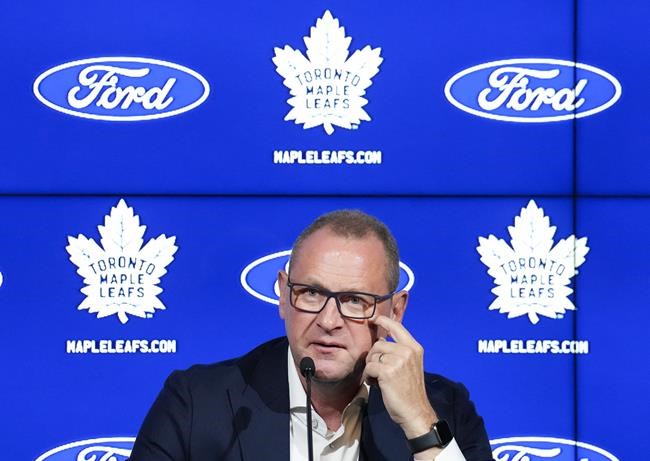
When the Maple Leafs — more specifically Brendan “Shanaplan” Shanahan — hired Brad Treliving in 2023, the move was described as sensible and safe. Apparently, Toronto wanted a grown-up at the wheel after the Kyle Dubas era ended abruptly and dramatically. But “safe” isn’t the same as “smart,” and a closer look at Treliving’s body of work — both in Calgary and now in Toronto — shows a track record that has always been more reputation than results.
Treliving spent nine seasons as GM of the Calgary Flames. Nine. That’s an eternity in today’s NHL. If a manager has Cup-building skills, nine years is more than enough time to shape a champion. Instead, in Calgary, he delivered two playoff-series wins. Yes…two. Zero conference-final appearances. No identity beyond “pretty good regular-season team that folds when it matters.”
His greatest achievement in Calgary was a single 50-win season in 2018–19 — a legitimate bright spot — but it was immediately snuffed out by a five-game elimination at the hands of the Colorado Avalanche. That was always the pattern under Treliving: flashes of promise followed by abrupt collapse and long, unproductive stretches. A perfect Maple Leafs candidate, some may jest.
One of the most damaging moments of Treliving’s Calgary tenure was letting the late Johnny Gaudreau walk away for nothing. A franchise player, coming off a 115-point season, simply allowed to leave as an unrestricted free agent with no meaningful assets coming back.
Elite GMs anticipate these scenarios — they trade early, re-sign early, or restructure early. They control the clock instead of reacting to it. Treliving misread the situation, mismanaged the timeline, and Calgary ended up empty-handed. That alarming failure remains one of the clearest indictments of his asset-management judgment.
As much as he would like to, Treliving will also never erase the Huberdeau–Weegar–Tkachuk disaster from his résumé. When Matthew Tkachuk wanted out, the Flames were stuck between a rock and a superstar. But elite GMs find a way to turn such moments into opportunity. Treliving turned it into a catastrophe. A trade that instantly shifted the Flames from contender to pretender
Jonathan Huberdeau has one of the worst value-for-money contracts in the league — a massive, long-term anchor signed on Treliving’s way out the door. The process, the return, and the contract extension were all lightning-rod decisions that set Calgary back years. The trade is already viewed as one of the most lopsided of the decade, and the consequences will likely be felt long after Treliving is done with this game.
When Brad Treliving arrived in Toronto, Leafs fans were told: “He’s experienced. He’s steady. He knows what he’s doing.” But experience only matters if it translates into smart, forward-thinking decisions.
Instead, Toronto has seen:
The Klingberg Gamble
John Klingberg was a sinking stock around the league. His defensive numbers were alarming, his mobility was declining, and he was coming off a messy season split between Anaheim and Minnesota. Yet Toronto — desperate for stability on defence — handed him a contract and top-four minutes before he even proved he could still play. It predictably blew up.
Poor Cap Allocation
Despite having a tight cap structure, a situation that demands careful precision, Treliving spent valuable dollars on players who did not move the needle. Toronto needed physicality, defensive reliability, and playoff-proof depth. Instead, they got a rotating cast of “maybe he’ll bounce back” pieces including Matias Maccelli, Dakota Joshua, and Nicolas Roy.
A Lack of Bold Vision
Dubas wasn’t perfect, but he had a clear, aggressive identity. Treliving, by contrast, feels like the GM equivalent of beige paint: safe, conservative, and rarely ahead of the curve. In today’s NHL — with creativity, analytics, and high-tempo roster construction driving success — that is not enough. It’s said that Treliving is “in” on almost every player made available for trade. If that’s so, fellow GMs must roll their eyes when good old Brad is on the other line, ready to talk but never walk the walk.
A Familiar Problem: No Playoff Impact
Toronto’s playoff issues are longstanding, but this year’s 2025–2026 group put together by Treliving does not look better constructed, tougher, deeper, or more balanced for postseason hockey. If anything, they look older, slower, and more expensive in the wrong places. A fatal combination in the modern NHL
In addition, Treliving’s apparent faith in coach Craig Berube — a topic for another day — seems misguided. In a league that continues to feature speed, youth, and more speed, Toronto’s archaic, straight-line dump-and-chase hockey looks worse than ever — especially when there’s a lot more dump than chase.
If Treliving had a history of deep playoff runs, bold trades that reshaped franchises, or a drafting record loaded with hidden gems, the Leafs could justify this hire.
Mind you, it’s hard to draft well when your picks have all been traded away. While Kyle Dubas is primarily to blame on that count, it was Treliving who surrendered two first-round picks late last season (and two solid prospects) to bring in Brandon Carlo from Boston and Scott Laughton from Philadelphia. In hindsight, these were two moves that mortgaged tomorrow without improving today even marginally.
Meanwhile, Montreal’s clever and aggressive front office swapped two first-round picks to the Islanders in exchange for the offensively gifted Noah Dobson, a right-shot, power-play quarterback in his prime — a key ingredient Toronto has been missing for years.
And now, in Toronto, the early returns feel uncomfortably similar: uncertain direction, questionable cap decisions, and no real sense of a blueprint.
Toronto needed a builder. Instead, it hired a caretaker — full of clichés and void of any real solutions. Brad Treliving is not the kind of GM who transforms a good team into a Stanley Cup team.
The Leafs needed someone with edge, imagination, and a track record of turning bold ideas into winning realities. Instead, they chose familiarity and caution. And in a league where windows slam shut fast — especially with superstar salaries climbing — that kind of decision can cost you a decade.
The harsh truth is simple:
Brad Treliving has never shown that he can build what Toronto desperately needs: a champion, not just a contender. His ceiling is stability — not greatness. Other teams can afford “safe.” Toronto can’t.