
• Have you ever robbed a bank and then gone online to whine about rising crime rates these days? What’s that got to do with hockey, you ask?
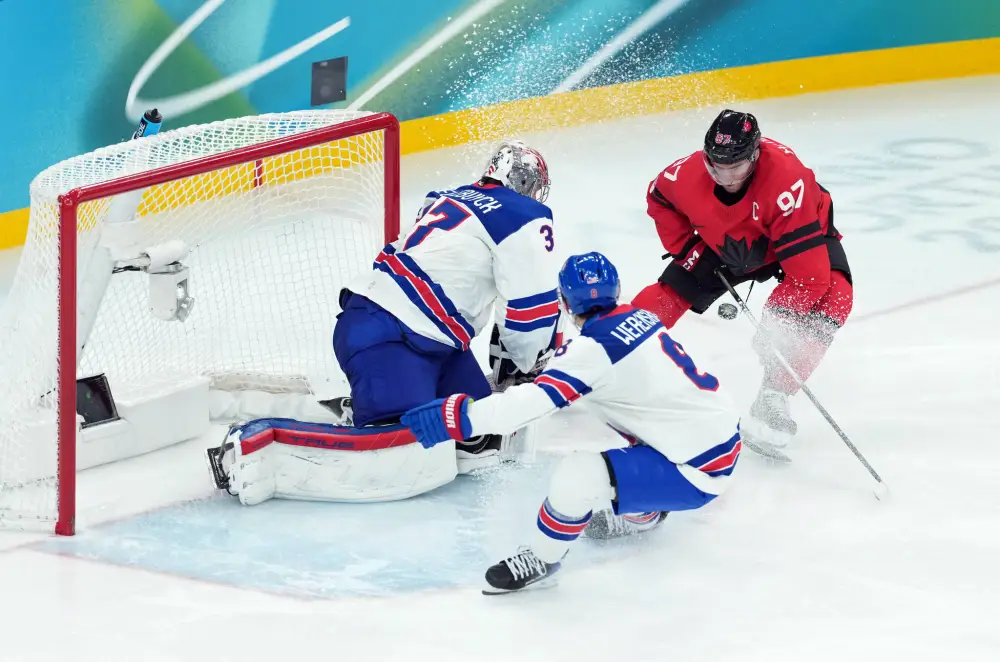
Well… there’s been a lot of chatter recently about the Olympic hockey arena in Milan, Italy possibly not being ready on time. Several insiders are now reporting that the biggest concern for the NHL isn’t the building itself — but rather the quality of the ice their “superstars-on-loan” will be expected to skate on. After all, substandard ice could lead to unnecessary injuries, they argue.
What? What? Isn’t this a perfect example of “the pot calling the kettle black”? The NHL’s own compressed schedule (to accommodate a three-week Olympic break) has already resulted — by many accounts — in a raft of injuries across the league. Even worse: the heaviest schedule blocks come after the Olympics. Things may get worse before they get better.
But don’t shed a tear for the NHL. This is the same league that complains about injuries out of one side of its mouth — while simultaneously announcing a longer regular-season schedule for next year out the other. Yep.
• The World Junior Championship is rapidly approaching. Millions of Canadian hockey fans — along with a few dozen Americans, some Swedes, a couple of Finns, and a Russian in a pear tree — treat this as their main holiday-season highlight.
Those familiar with this annual tradition will once again be forced to endure giddy play-by-play announcers and their colour-commentary sidekicks, declaring every player who touches the puck to be the “next generational superstar,” possibly the greatest skater ever.
And then — half a decade later — most of them are either playing in Europe’s low-tier leagues or flipping burgers somewhere. Okay, maybe a bit of hyperbole there, but the simple truth is that only a small portion of these players go on to become regular NHLers.
A study covering the 2010–2019 drafts found that of 1,905 drafted skaters, only 418 had reached 200+ NHL games — roughly 22%.
Even an older analytics study (drafts 1988–1997) found that only around 25% of drafted forwards, 21% of defensemen, and 19% of goalies ever played more than 200 games.
So, for the past 20–30 years, a useful rule of thumb has been: only about 20–25% of drafted players ever carve out a “real” NHL career (200+ games).
Flip it around — three out of four draft picks never truly stick in the league beyond more than a cup of coffee.
• Probably because of his current age, his longevity as an NHL general manager (New Jersey, Toronto, New York Islanders), and the fact he no longer calls the shots anywhere, Lou Lamoriello is treated as almost Pope-like by the chattering heads on NHL broadcasts, websites, and podcasts.
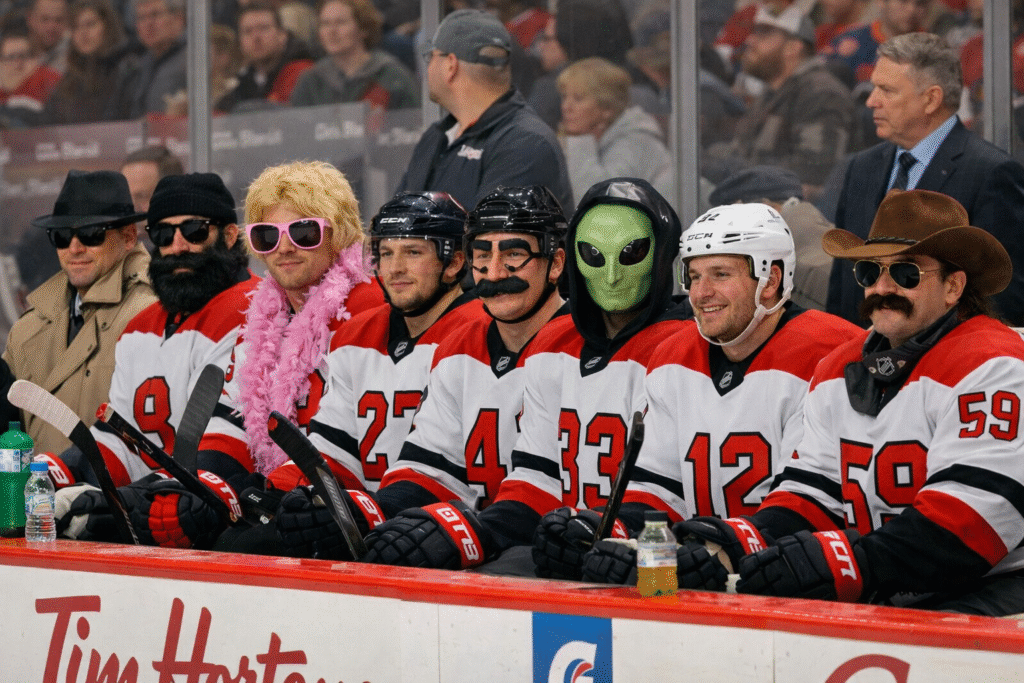
Old-school Lou was well known for strict, team-wide bans on long hair, facial hair, individual flamboyance, sloppy wardrobe choices, uncommon jersey numbers (no 13, no 36–99) and more
What once worked, doesn’t have the same impact anymore. It’s been a long time since a Lamoriello-led club was indisputably among the league’s elite, year-in, year-out. His recent teams have struggled to consistently reach upper-tier status, and today’s NHL — with its salary-cap, speed, and evolving style — seems increasingly incompatible with his old-school thinking.
Surely by now Lou realizes what truly wins hockey games is talent, skill, and depth — not hairdos or jersey numbers. Consider the career of the man widely regarded as the greatest coach in NHL history, Scotty Bowman.
Bowman’s head-coaching résumé? 1,248–574–314 in the regular season, plus 223–130 in the playoffs — a staggering 1,471 career wins. Hidden in those totals is the reminder that Bowman’s ill-fated stint with the Buffalo Sabres ended poorly — mostly because the roster lacked the needed talent.
So now, we wonder: would Lou concede that a long-haired champion might just be more valuable than a clean-shaven also-ran?
Still, we’ll admit one thing—Lou would’ve made an excellent Pope.