Once upon a time, NHL coaches preached a simple philosophy: “Throw the puck on net.”
Today?
Apparently, the modern strategy is: “Avoid shooting for long stretches, hope your goalie performs witchcraft, then score once on a weird bounce and celebrate like you invented hockey.”
Welcome to the NHL’s latest trend: playoff games where teams barely register enough shots on goal to justify having goalies guarding the nets.
The Montreal Canadiens have become the face of this bizarre movement. In the previous round against the Buffalo Sabres, the Canadiens somehow won a playoff game despite recording just nine shots on goal for the entire game. Nine. That’s not a typo.
The Canadiens followed that oddity up with two similar disappearing acts against Carolina. In game two of the series, Montreal racked up 3-2-7-0 shots per period (12 total) before losing in overtime. In game three, the Habs surged to 3-2-7-1 shots per period (13 total) despite playing 14 minutes of overtime hockey. And yet, they were one lucky bounce away from stealing both games.
At this point, if Montreal reaches 15 shots in a game, Bell Centre fans may start throwing hats onto the ice. The scary part? This isn’t just a Canadiens thing anymore.
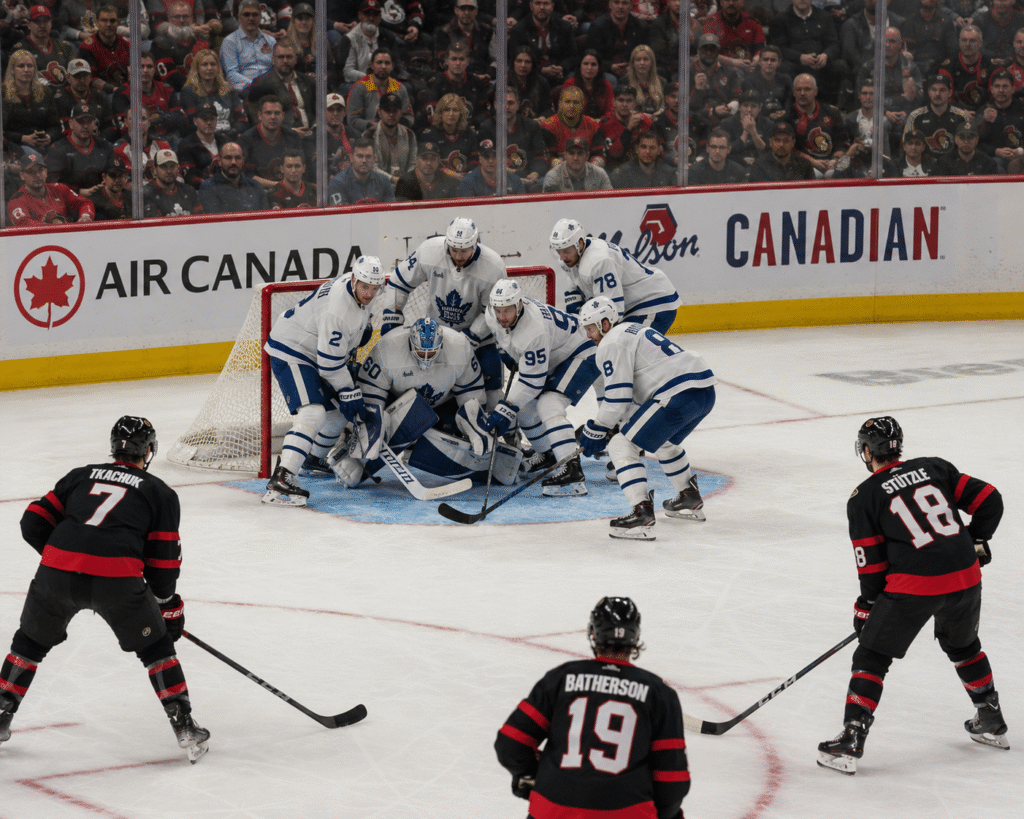
Around the NHL, playoff hockey has become a low-event survival contest where teams spend half the night collapsing into defensive formations that resemble Muhammad Ali’s famous rope-a-dope strategy.
Across the league coaches insist their players block shots, clog passing lanes, and stack their formations between the circles. They speak lovingly about “getting pucks deep,” “managing the game,” “limiting chances” and everybody’s favourite sleep-inducing term “playing the right way.”
We’ve essentially arrived at hockey’s version of soccer, except with sharper skates, more cross-checking and more sophisticated diving.
And yes, analytics people will argue that “shot quality matters more than quantity.” Fair enough. Nobody’s saying a 60-foot muffin from the boards should count the same as an inner-slot one-timer. But there’s also something deeply absurd about professional hockey teams spending entire periods generating less offense than a public skating session.
In one recent Montreal playoff game, the Canadiens reportedly went over 26 minutes without registering a single shot on goal. Twenty-six minutes! That’s nearly half a hockey game spent treating the opposing goalie like an endangered species that must not be disturbed.
Imagine explaining this to fans from the 1980s. “Hey guys, great news. One day playoff teams will intentionally spend entire nights defending, dumping the puck out, changing lines, and hoping for a lucky bounce.”
The New York Islander’s former sniper Mike Bossy would’ve retired by the first intermission. Bossy averaged 57 goals per season until his chronic back problems ended his career prematurely. And he did so by simply shooting the puck. And as he explained more than once, he unleashed his lightning quick release without looking, without aiming. Said Bossy: “If you have time to aim, the goalie has time to stop it.”
But today’s NHL coaches beg to differ. They are handsomely paid—and they want those large payments to keep flowing their way. They are also keenly aware that defensive hockey reduces risk. Some observers argue the modern NHL has become so structured that teams are content to generate only a handful of dangerous chances rather than pile up harmless perimeter shots.
To be fair, close playoff games tend to create tension. Every goal feels massive. Overtime games are even more dramatic. But all of that is just as possible in a 6-5 game, is it not?
We’re told that today’s NHL players are more skilled than ever. And yet, instead of watching Colorado’s Nathan MacKinnon dancing around the offensive zone before unleashing a wicked snapshot on goal, we last saw him writhing on the ice after blocking an incoming shot and missing the balance of the period. Structure baby, structure.
Ah yes, who wants to enjoy skilled offensive plays when we can instead enjoy three hours of non-stop defensive structure?