
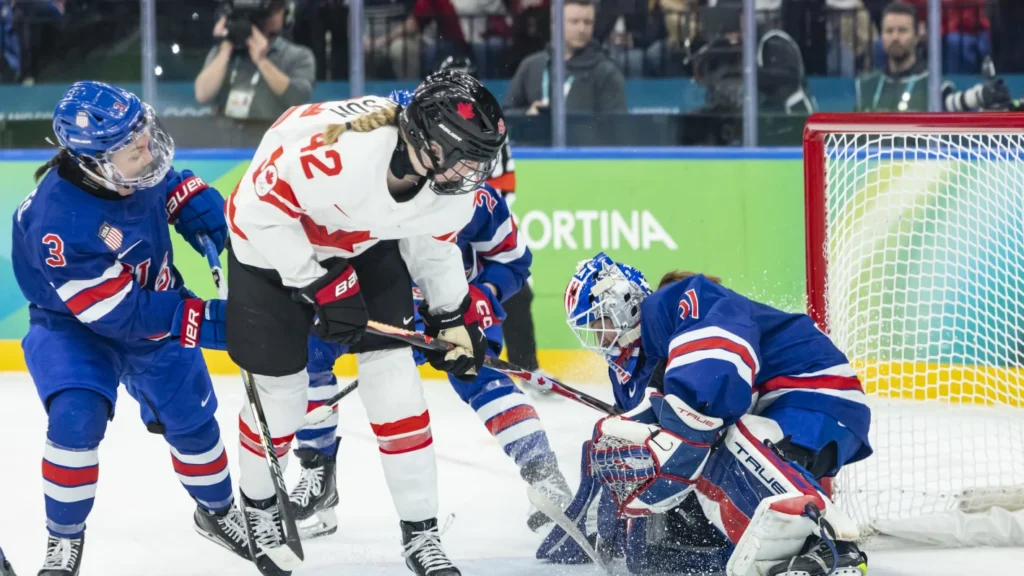
The PWHL website recently featured an interesting perspective on the recent Olympic experience for many of its players.
If you watched the 2026 Winter Olympics and thought, “Wow… this feels faster, tighter, and nastier—in a good way,” you weren’t imagining things. Clearly, that was the PWHL effect on display. And no, that’s not a new fancy advanced stat, but clearly something that easily passes the eye test.
According to the PWHL’s own reporting, a whopping 61 league players competed in Milano-Cortina, with 41 returning home as medalists. Veteran players who’ve been to multiple Olympics said the biggest change wasn’t the tournament itself, but rather the runway leading into it. Before the PWHL existed, Olympic prep often meant scattered schedules, uneven competition, and long stretches without elite-level games.
Now? Players are grinding through a full pro season, facing the best in the world every single night—which basically turns the Olympics into the PWHL on steroids.
The odd part? For the first time ever, Olympic opponents weren’t just rivals—many were teammates a few days earlier. That meant linemates suddenly trying to shut each other down, goalies facing shooters they’ve seen 100 times in practice, and defenders knowing exactly which fake is coming next. And yes—probably with a little extra chirping.
Such familiarity meant the margins were tight:
Gold medal game: USA over Canada, 2-1 (Overtime)
Bronze medal game: Switzerland over Sweden, 2-1 (Overtime)
Players who experienced both “pre-PWHL Olympics” and “post-PWHL Olympics” didn’t hesitate to declare that this was the best overall product women’s hockey has ever produced internationally. A product based on better conditioning, increased tempo, improved structure, and more high-end skill performing under pressure.
Here’s the part that might matter most long-term: For the first time, fans who fell in love with Olympic women’s hockey don’t have to wait four years. They can just… keep watching the PWHL. The PWHL enhances Olympic hockey. And Olympic hockey enhances the PWHL. A classic example of the sum being greater than the parts.