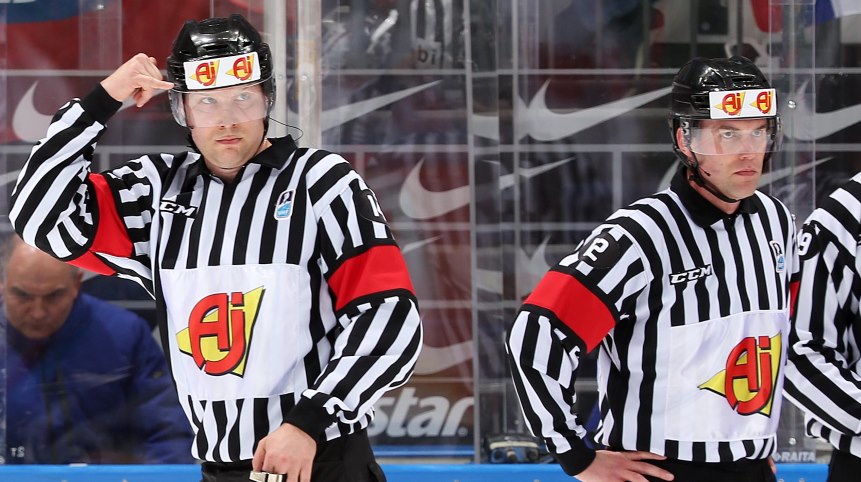
It’s Christmas time, which also means the World Junior Championships are gearing up for puck drop. And once again, Gary Bettman, the NHL, and its referees are about to get a lesson in how it’s done.
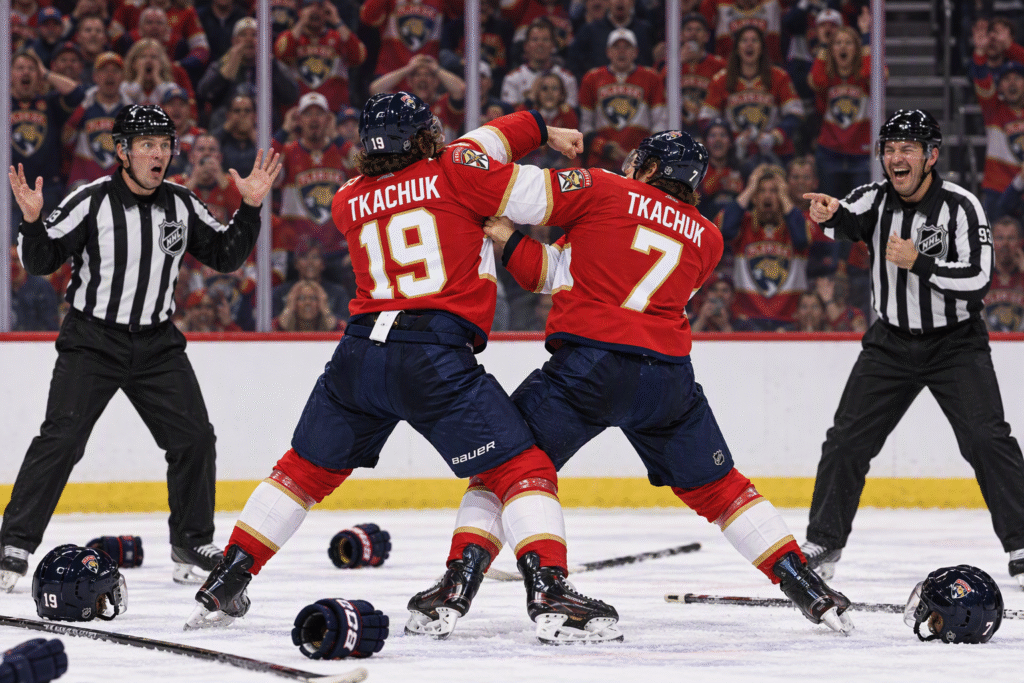
While Bettman loves to tell anyone who will listen that his NHL referees are the best in the world, his claim is laughable. International referees handle both the junior event and the men’s World Championship (every spring) with a consistency Bettman can only dream of.
International officials just call the game — no “it’s a close game” excuses, no late-game let-ups, no “even-up” calls. By contrast, NHL officiating often feels like a roller coaster: early tight whistles, then a late-game “let them play” policy that can determine momentum — even outcomes.
There’s a reason this perception is more than just fan frustration. It comes down to how referees are evaluated, trained, and directed to apply the rule book — and the result is two very different officiating philosophies at work on the same ice.
At World Juniors and IIHF World Championships, the game is officiated under the International Ice Hockey Federation (IIHF) rule framework and development system.
The IIHF’s officiating philosophy is explicit:
Apply the rule book regardless of score or time.
Penalize similar infractions consistently throughout a game.
Avoid modifying rule discipline based on game flow or situation.
In fact, the IIHF’s officiating development guides list “not allowing score/time to dictate enforcement” as a key evaluation point when supervising referees.
What this means on the ice is simple: instead of thinking “Do we need to manage this here?” referees are trained to think, “Did the rule get broken?” If the answer is yes — the whistle blows and it’s off to the sin-bin for one or more skaters.
Sure, international officials still make mistakes — everyone does — but those mistakes tend to come from what they thought they saw, not what they want to let go to manage the game. The IIHF standard forces the call to align with the rules, not the scoreboard, and not the importance of a particular game.
Contrast that with the NHL officiating we’ve endured for years. Multiple academic studies have examined penalty trends in the NHL and found patterns that suggest penalty calling isn’t always what it should be. Factors like score differential, time remaining, and prior calls have measurable impacts on how referees enforce (or don’t enforce) penalties.
Some of the key patterns:
Penalty calling tends to suppress as the game gets later and tighter. Instead of calling a hooking or interference call in the final minutes, refs often “let them play” to avoid influencing the outcome.
After a penalty against one team, the next penalty is statistically more likely to go to the other side — reflecting either a subconscious or intended attempt to balance the game, not pure rule application.
Official NHL guidance allows room for “game management” — meaning referees are evaluated not just on rule enforcement, but also on judgment calls about when to get involved and when to stay out of it.
This combination of fluctuating game management and real-time game situations — especially in meaningful late-season or playoff games — creates the feel of inconsistent officiating. Fans notice when the first two periods are tightly called and the third period suddenly isn’t. Coaches build strategies around it. Players adapt to it.
At international events, penalties feel like penalties — they are consequences of player’s actions, and nothing else. Fans, players, and coaches respect that clarity.
When players know each infraction will be treated the same regardless of the scoreboard, discipline rises. You don’t skate on the edge thinking “maybe they’ll let this one slide.”
International referees reinforce the idea that the rules determine the game, not the officials’ interpretation of what’s at stake. That’s closer to the ideal of officiating as an impartial decision-maker, not a game flow manager.
Let’s not forget that former NHL referee Tim Peel lost his job when he was caught on a hot-mic suggesting he “wanted” to call a penalty against Nashville early in the period of a Predators-Red Wings game to balance things out.
From the Associated Press: The Predators won 2-0 and were called for four penalties, compared with the Red Wings’ three. Nashville’s Matt Duchene on a local radio appearance Wednesday wondered aloud what would have happened if Detroit scored on the power play, won the game and the Predators missed the playoffs by a point. “The crazy part is he was talking to (teammate Filip) Forsberg in that clip, and he told our bench that. Really bizarre,” Duchene said. “I’ve always been frustrated when I’ve seen even-up calls or stuff like that. If one team is earning power plays, you can’t punish them because the other team is not.”
Being caught red-handed on an audio clip forced the Bettman Hockey League to take action. Referee Peel was let go. But then again, he was on the verge of retiring anyway. No real harm done there. At the same time, this was a great opportunity for the NHL to push back on criticism of their officials. Which changed nothing in the long run. Carry on boys—nothing to see here.
Also from the Associated Press: “Watch what happens at the end of games,” said Carolina coach Rod Brind’Amour, a former centre who played maore than 1,600 NHL games. “It seems to always get a power play, the team that’s behind. I think it’s just human nature. It’s hard. I know they’re not trying to do that. I don’t believe that that’s how they go about it. It’s just human nature to maybe look for the team that’s down, but it seems to happen all the time.”
Not trying? We disagree. They’re trying alright. Trying to keep their jobs.
References
-
IIHF Officiating Development Program — Supervision & Evaluation Principles (official directive emphasizing consistency regardless of score/time).
-
Beaudoin, Schulte & Swartz (2016). Biased penalty calls in the NHL: Evidence of situational effects and imbalance. — Shows situational patterns related to score/time in NHL penalty calling.
-
Lopez (2013). Biased impartiality among NHL referees. — Statistical evidence of “balancing” patterns in consecutive penalty calls.